



Energy efficiency now accounts for 80% of the total operating cost of a cooling installation over a ten-year period. This strategic lever directly affects the competitiveness of industrial sites in the face of volatile energy prices.
Poor thermal management can lead to costly production stoppages or premature equipment deterioration. This article details the industrial cooling solutions for your production process to optimize your performance and regulatory compliance. Let’s review them together.
Contents
Industrial cooling solutions for your production process
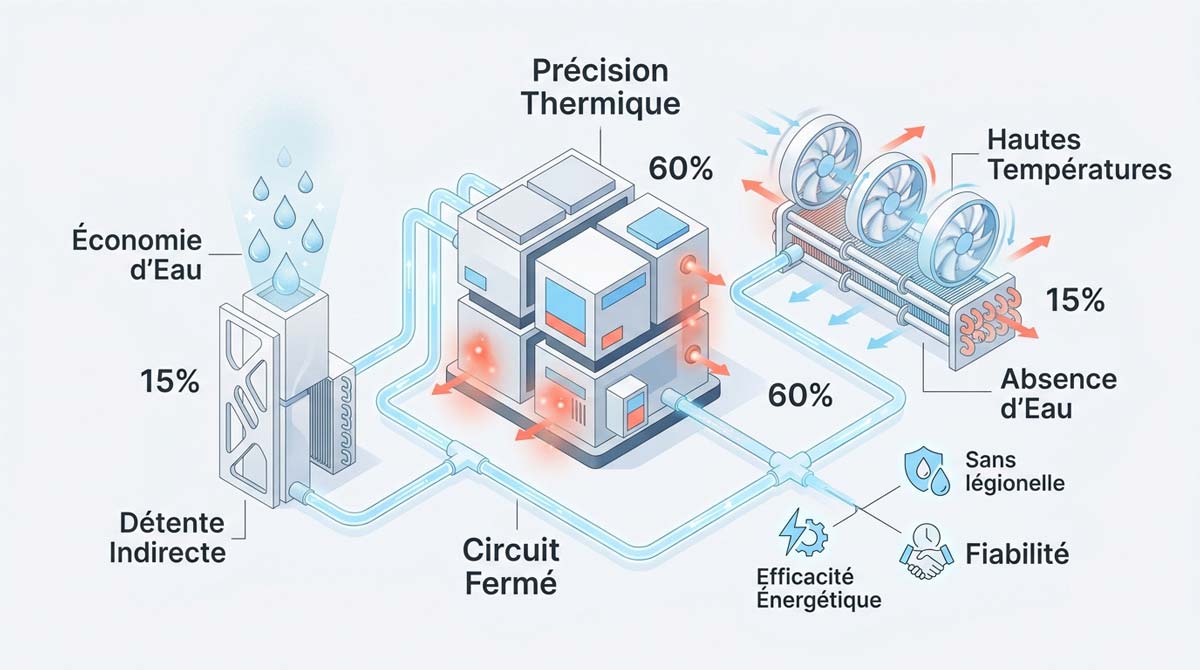
Industrial cooling relies on three major technologies: chillers for precision, adiabatic systems for water savings and dry coolers for high temperatures without water consumption.
This technological diversity starts with an analysis of mechanical chillers, the pillars of high-performance closed circuits.
Mechanical chillers and chilled water systems
Chillers operate in a closed circuit to extract heat from your equipment. This setup ensures the thermal stability essential to protecting your industrial machinery.
Indirect expansion drastically limits the volume of refrigerant needed in the installation. Using glycol water makes it possible to reach sub-zero temperatures with extremely precise control.
These systems offer total reliability. They maintain a constant temperature for your most demanding processes.
Adiabatic cooling and cooling towers
The efficiency of adiabatic systems exceeds that of conventional towers without the health constraints. The absence of permanent spraying eliminates any Legionella risk for your staff.
Pre-cooling the ambient air greatly reduces overall water consumption. This technology is perfectly suited to the Belgian climate, especially during summer heatwaves.
The energy efficiency of these units is remarkable. Their maintenance is much simpler than that of traditional open cooling towers.
Dry coolers for high-temperature processes
Dry coolers efficiently handle high-temperature fluids. Heat exchange takes place between air and liquid through high-performance finned coils.
You benefit from zero water consumption with this equipment. This simplifies resource management while reducing preventive maintenance operations.
Outdoor configurations use axial fans to reject heat. Here are the main features of these installations:
- Modular ventilation
- Small footprint
- No chemical water treatment
4 technical criteria for selecting your cooling installation
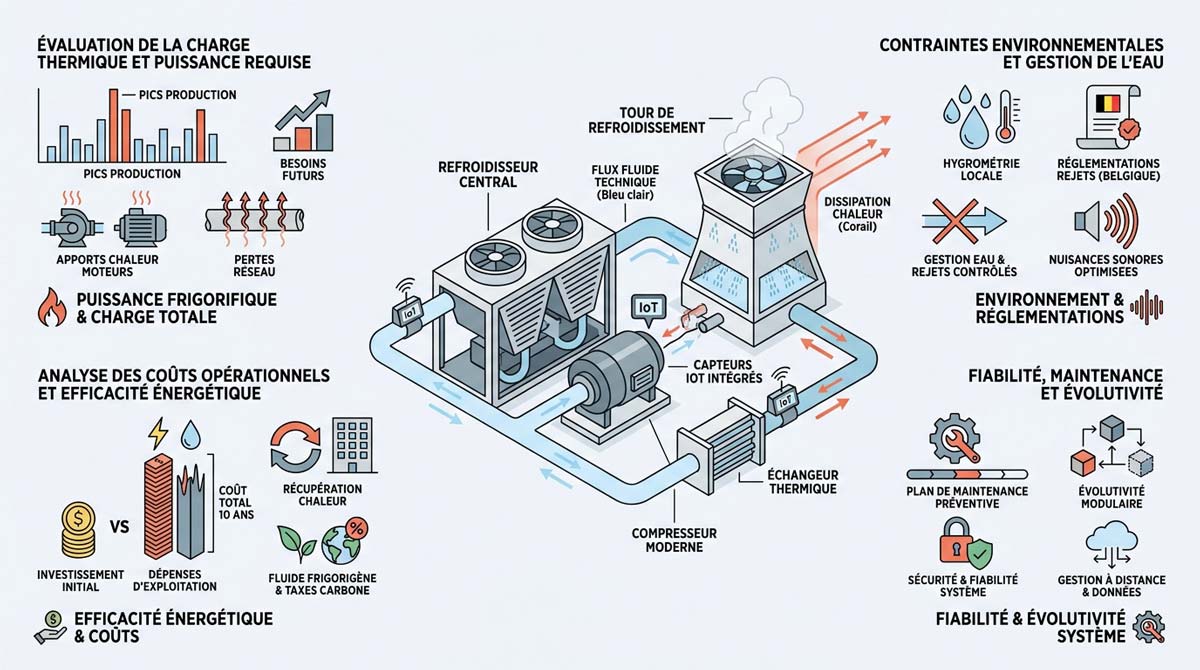
Beyond the choice of technology, the success of your project depends on rigorous calculation parameters and specific local constraints.
Assessing the thermal load and required capacity
Calculate the cooling capacity taking your production peaks into account. Add the heat gains from pumps and electric motors. This step is the essential foundation of your thermal sizing.
Accurately assess heat losses in your distribution network. Insufficient pipe insulation needlessly wastes your capacity.
Anticipate your future production expansions. Undersized equipment will wear out prematurely and increase your corrective maintenance costs.
Environmental constraints and water resource management
Analyze the local humidity at your industrial site. In Belgium, relative humidity directly affects the efficiency of adiabatic and evaporative systems depending on seasonal variations.
Comply with Belgian regulatory thresholds for thermal discharges. Water abstraction is regulated by the regional authorities to preserve the balance of groundwater tables.
Determine the location based on noise constraints. Unobstructed airflow ensures heat rejection without disturbing your immediate neighbors.
Analysis of operating costs and energy efficiency
Compare your initial investment with future operating expenses. Electricity and water often reach 80% of the total cost of ownership over ten years.
Always make use of waste heat recovery. This rejected heat can heat your storage areas or offices at no additional cost.
Study the impact of the refrigerant on your future taxes. Favor reducing high global warming potential refrigerants to anticipate restrictions under the F-Gas regulation.
Ensuring continuity of service and machine performance
A well-sized installation is not enough; its longevity depends on proactive maintenance and flawless responsiveness when problems arise.
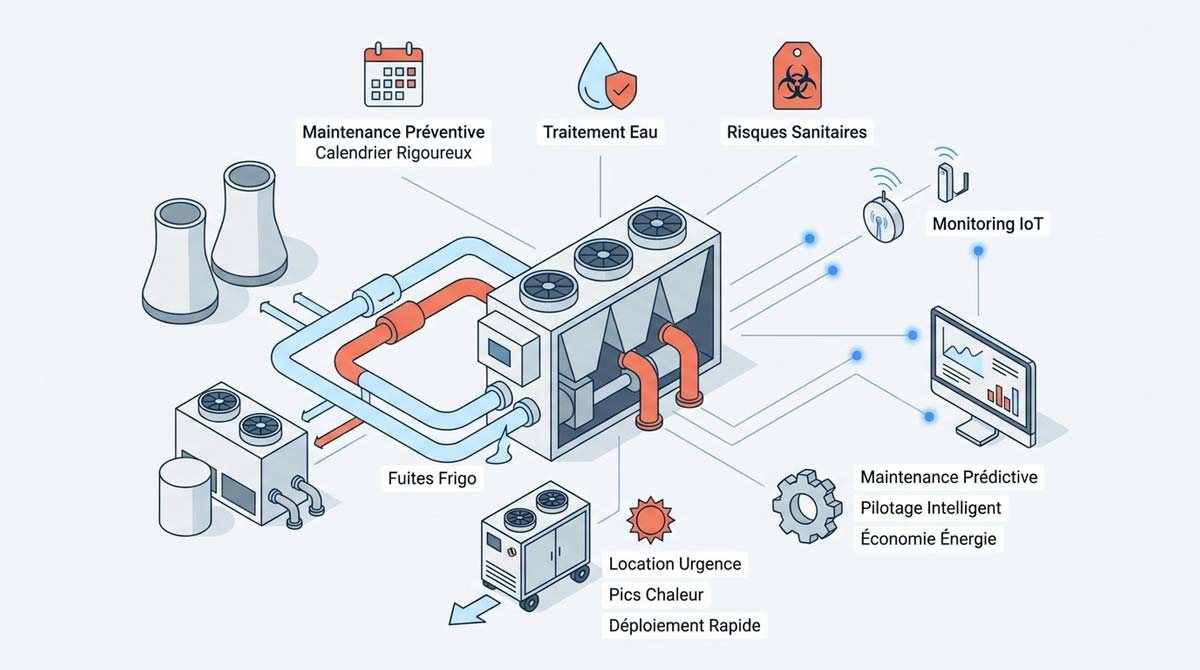
Preventive maintenance against Legionella and corrosion risks
Establish a rigorous schedule of inspection visits. Checking the condition of exchangers and pumps helps avoid unexpected and costly production stoppages for your company.
Plan for bacterial growth in the circuits. Chemical or physical water treatment is essential to rule out any health risk related to Legionella in your installations.
Detect refrigerant leaks quickly. This maintains rated efficiency and limits the environmental impact of your industrial cooling installation in Belgium.
Emergency rental to cope with heat peaks or breakdowns
Use mobile chillers to secure your processes. In summer, these units support production when permanent installations reach their original design limits.
Renting a mobile, temporary industrial chiller also makes it possible to quickly deploy additional cooling capacity. This solution ensures the continuity of your operations during a breakdown, a production peak or major maintenance work, without interrupting your production lines.
Keep your finances under control thanks to the flexibility of rental. In fact, this strategic choice offers immediate technical security without tying up significant capital for your organization.
Rental turns a heavy investment into controlled operating expenses, offering total flexibility in the face of unforeseen climatic or technical events.
IoT monitoring and smart Industry 4.0 control
Install connected sensors to monitor pressures. Real-time data makes it possible to identify performance drifts well before a breakdown actually occurs.
Analyze operating cycles for predictive maintenance. Artificial intelligence helps optimize maintenance intervals based on the actual use of machines and compressors.
Adjust cooling set points remotely. This fine-tuned management reduces energy waste and extends the service life of your production equipment.
| Technology | Average PUE | Main advantage |
|---|---|---|
| Air-cooled units | 1.4 | Easy installation |
| Water-cooled units with free chilling | 1.2 | High energy efficiency |
| Direct liquid cooling | 1.1 | High-density heat dissipation |
Key takeaway: choosing an industrial cooling system in Belgium depends on the required thermal precision, hygiene standards such as HACCP and PUE optimization. Whether emergency rental or a permanent installation, energy efficiency remains the main competitiveness lever for technical decision-makers.
Specific adaptations to the requirements of Belgian industrial sectors
Each sector has its own thermal constraints, requiring tailor-made solutions to guarantee the quality of finished products.
Controlling the cold chain in the food industry
Guarantee constant temperatures for sensitive storage. Thermal precision is vital for food safety and for preserving organoleptic qualities. Any temperature deviation compromises sanitary compliance.
Meet hygiene standards with cleanable exchangers. High-performance cryogenic cooling makes it possible to quickly reach the required thresholds. The design must facilitate strict disinfection protocols.
Manage the thermal loads of cleaning cycles. Systems must quickly absorb heat peaks after hot-water washing. This responsiveness protects the integrity of nearby products.
High-precision cooling for chemicals and pharmaceuticals
Maintain tight thermal tolerances for chemical reactions. A deviation of a few degrees can ruin an entire batch of medicines. Stability is an absolute priority here. No compromise is possible on fine control.
Install redundant systems to avoid any interruption. Process safety relies on duplicating cooling units. In the event of a failure, backup must be immediate and automatic.
Adapt materials to ATEX environments. Circuits must withstand corrosive fluids while complying with explosive-atmosphere safety standards. The durability of the components ensures the longevity of the industrial installation.
Thermal management of data centers and servers
Dissipate the heat densities of IT racks. Direct liquid cooling delivers superior performance to keep PUE low in data centers. This technology limits massive energy losses.
Favor free cooling in Belgium. By taking advantage of moderate outdoor temperatures, you drastically reduce the power consumption of mechanical chillers. Here is a comparison of energy performance by technology:
| Technology | Average PUE | Main advantage |
|---|---|---|
| Air-cooled units | 1.4 | Easy installation |
| Water-cooled units with free chilling | 1.2 | High energy efficiency |
| Direct liquid cooling | 1.1 | High-density heat dissipation |
Contact our experts for a free quote. Our teams support you in sizing your future industrial cooling infrastructure. We ensure the continuity of your critical services.
Optimizing the industrial cooling solutions for your production process ensures crucial thermal stability and lasting energy efficiency. By integrating the right technologies and preventive maintenance, you secure your future profitability in the face of climate challenges. Performance and reliability are the keys to your operational excellence.
FAQ
How do you select the most suitable cooling technology for an industrial process?
Choosing a cooling solution is based on a rigorous analysis of your thermal needs, the required set-point temperature and resource constraints. For fluid temperatures above ambient air, dry coolers offer easy maintenance and zero water consumption. Conversely, if your process requires a temperature below the outdoor air, a mechanical chiller or chilled water system becomes essential to ensure thermal precision.
Geographical and regulatory factors must also be taken into account, such as local humidity in Belgium, which affects the efficiency of adiabatic systems. Weighing the initial investment against future operating costs, including electricity and maintenance, should guide your decision to ensure the long-term profitability of the installation.
What are the concrete benefits of chilled water cooling for production?
A chilled water system, generally operating with indirect expansion, makes it possible to limit the volume of refrigerant within a centralized production unit. This configuration reduces the risk of leaks in production areas and simplifies equipment handling. Using glycol water as the heat transfer fluid offers great flexibility to supply several indoor units with extremely fine temperature control.
In terms of energy, these installations often allow reduced consumption compared to conventional direct expansion systems. They also facilitate the integration of heat recovery technologies, turning the heat rejected by your machines into a free resource for heating your premises or other stages of your process.
What is adiabatic cooling and why consider it?
Adiabatic cooling uses the physical principle of water evaporation to lower the air temperature. This technology is an ecological and economical alternative to traditional air conditioning, as it does not require energy-intensive compressors or refrigerants with a high environmental impact. It is particularly effective during summer heat peaks, securing production without energy costs skyrocketing.
Modern systems, especially two-stage (indirect/direct) solutions, can reach low temperatures while limiting the addition of humidity. In addition, the absence of permanent water spraying in some adiabatic models eliminates the health risks related to Legionella, simplifying regulatory and maintenance constraints compared to conventional cooling towers.
How do you accurately assess the thermal load of an industrial site?
Calculating the thermal load requires distinguishing between external gains and internal heat sources. External factors include solar radiation on walls and air infiltration, while the internal load accounts for the heat released by motors, machine tools, ovens and lighting. It is essential to include production peaks and heat losses in the distribution network to avoid undersizing the installation.
Using reference standards such as NBN EN 12831-1 makes it possible to establish a reliable heat balance. Accurate sizing not only ensures the longevity of your equipment by avoiding premature wear, but also optimizes energy consumption by matching cooling capacity to the actual needs of your infrastructure.
Why choose to rent a chiller in an emergency?
Renting mobile cooling units is an essential safeguard against unexpected breakdowns or exceptional heatwaves that could overload your permanent installations. This solution offers immediate responsiveness to maintain continuity of service and avoid costly production stoppages. It also allows major maintenance on your main equipment without interrupting your business.
From a financial point of view, renting makes it possible to turn capital expenditure (CAPEX) into controlled operating expenses (OPEX). This flexibility is a major asset for companies wishing to adjust their cooling capacity on a one-off basis without committing heavy long-term capital.
How does Industry 4.0 optimize industrial cooling management?
Integrating IoT sensors and smart monitoring platforms enables real-time monitoring of your installations’ performance. By analyzing pressures and operating cycles, it is possible to identify energy drifts and prevent breakdowns before they occur. This predictive maintenance approach extends the service life of compressors and ensures consistent efficiency.
Remote control also makes it possible to adjust temperature set points according to actual process needs or energy prices. This fine-tuned management, combined with artificial intelligence, turns your cooling system into a dynamic production tool capable of self-optimization to reduce resource waste.