



Oversizing your refrigeration installation can increase operating costs by 45%, while an undersized unit risks motor failure. How do you choose the capacity of a chiller to ensure the stability of your industrial processes?
A miscalculation of the thermal load exposes your temperature-sensitive products to critical cycle interruptions. This article helps you accurately quantify your cooling needs and select the right equipment for your production constraints.
Contents
Understanding the basics of choosing chiller capacity
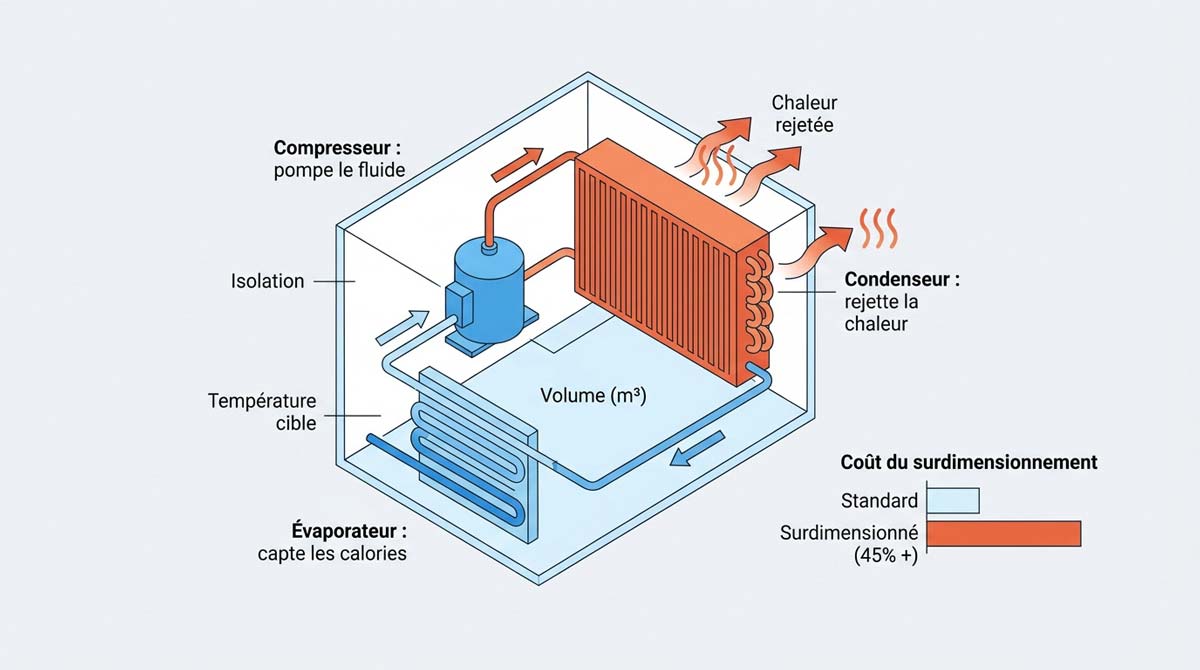
Cooling capacity is calculated based on volume (m³), insulation and target temperature. Undersizing causes breakdowns, while oversizing increases operating costs by 45%. Mastering the thermodynamic cycle ensures this efficiency.
Correctly sizing your industrial installation starts with a rigorous analysis of the internal components and their thermal synergy.
How the refrigeration circuit and its components work
The compressor acts as the central engine of the system. It pumps the refrigerant to raise the gas pressure. The accumulated heat is then rejected at the condenser.
The evaporator absorbs heat from your premises. The refrigerant changes state to cool the ambient air. A faulty component reduces the total capacity available on your site.
The expansion valve plays a regulating role in this cycle. It precisely controls the refrigerant flow. This technical consistency ensures a stable temperature and controlled power consumption.
Differences between packaged units and split units
Packaged units are attractive for their quick installation. Everything is integrated into a single frame. This is ideal for temporary needs or confined industrial spaces.
Split systems separate the evaporator from the condenser. This configuration optimizes thermal performance. It allows heat to be rejected far from the sensitive storage area.
Choosing between a packaged unit and a split system radically changes how heat flows are managed and the overall energy efficiency of your installation.
Analyze the physical constraints of your building. The distance between units affects the actual capacity. Choose based on accessibility for maintenance and the noise level tolerated on site.
Contact our experts for accurate sizing of your installation.
Assessing the thermal load based on your environment
But before choosing equipment, you need to accurately quantify the actual thermal needs of your storage volume.
Calculating volume and the influence of thermal insulation
Measure the length, width and height of your premises. The total volume is the basis of the cooling calculation. Do not overlook any dead zones. A poorly estimated volume skews the entire capacity study.
Wall insulation limits heat gains. Thick sandwich panels reduce the required load. A poorly insulated wall forces the unit to run continuously. It is therefore essential to ensure adequate insulation to minimize losses.
Quantify heat losses per square meter. Use accurate conductivity coefficients. Good airtightness saves your energy budget and extends the life of the compressor.
Set-point temperature and the specific nature of stored products
The desired temperature dictates the required capacity. Storing fresh products differs from frozen storage. The capacity of the refrigeration unit depends directly on this temperature difference.
Factor in the specific heat of your goods. Some products release energy as they cool, such as fruit or dairy products. The thermal load varies depending on the nature of the stock.
Adjust your calculations for high thermal inertia. Products entering warm require a massive initial effort. Plan for this peak demand to avoid any break in the cold chain.
Analyzing internal heat gains and air changes
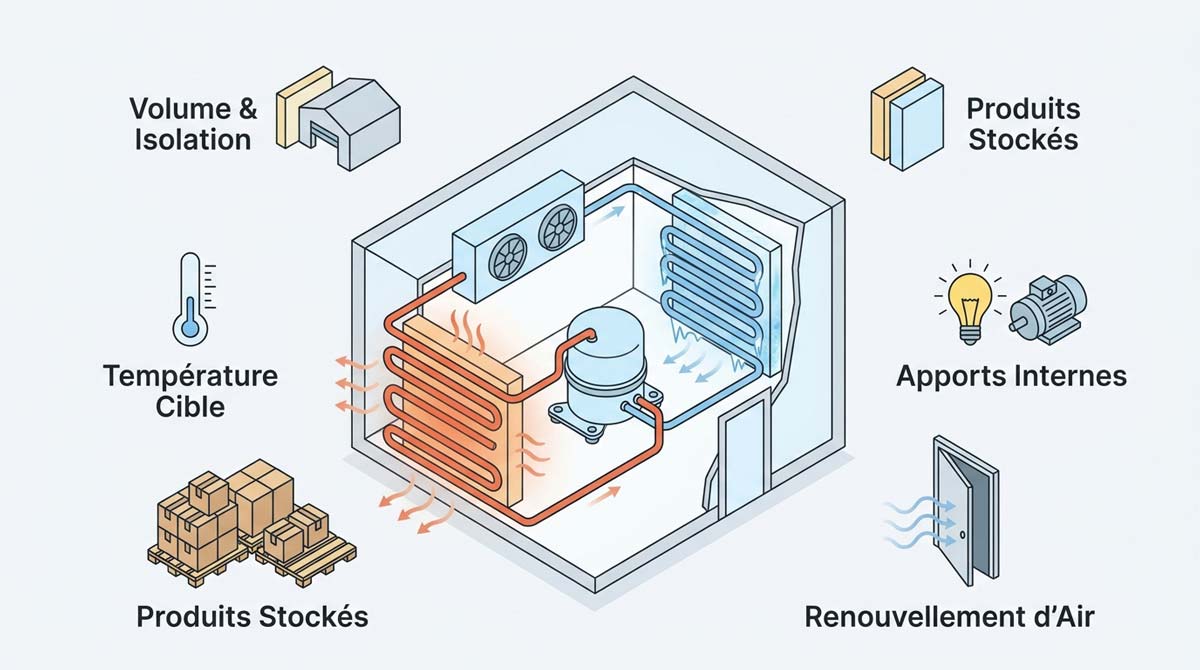
List the lighting and motors present. This equipment heats the ambient air. Every electrical watt consumed inside is often converted into heat that must be removed.
Count the staff working in the area. Human metabolism releases significant energy. The more intense the activity, the more the cooling requirement mechanically increases.
Assess how often doors are opened. Outside air rushes in with every passage. Use air curtains to limit this impact. Air changes account for a major share of heat gains.
- Internal heat sources: LED or sodium lighting
- Electric motors
- Human presence
- Air infiltration through openings
Contact our experts for accurate sizing and long-lasting industrial installations in Belgium.
Sizing with a technical safety margin
Once the loads have been identified, you need to apply safety factors to cope with unforeseen climatic or operational events.
Applying a safety factor to cope with variations
Always add a capacity reserve. A margin of 10 to 30% is recommended. This protects your installation against unforeseen technical or climatic events.
Anticipate seasonal peaks in activity. Occasional storage overloads require more resources. Without this margin, the unit quickly runs out of breath. The indoor temperature may then drift dangerously.
Avoid undersizing at all costs. An undersized unit wears out prematurely. It creates a risk of excess consumption due to poor sizing without reaching the set point. The reliability of your production depends on it.
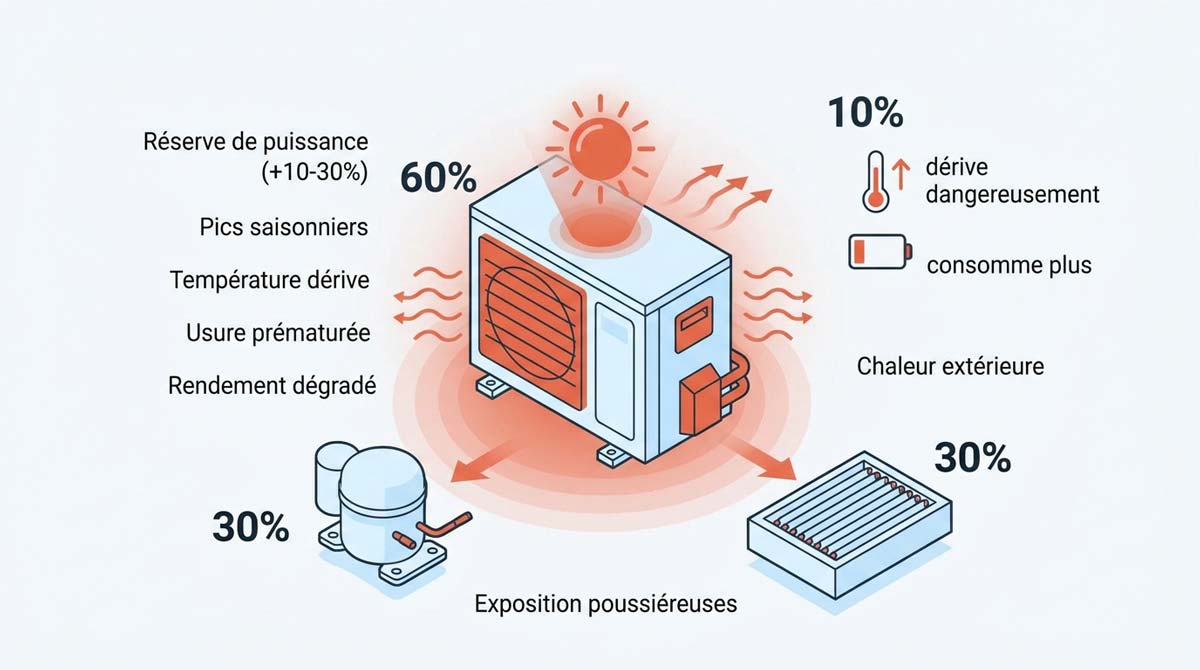
Impact of climatic conditions on condenser performance
Outdoor heat degrades performance. The condenser struggles to reject heat. In Belgium, heatwaves are becoming a major risk factor.
Adapt the equipment to its geographical exposure. A unit facing due south suffers more. Choose models capable of operating at an outdoor temperature of 35°C. Rated performance often drops during summer peaks.
Clean the condenser fins regularly. Dust blocks heat exchange. Simple maintenance ensures that capacity is maintained even under a blazing sun.
Choice of refrigerant and thermal efficiency
Beyond raw capacity, the choice of refrigerant determines the longevity and running costs of your machine.
Influence of the refrigerant on capacity and F-Gas compliance
Refrigerants do not all have the same capacities. Some perform better for sub-zero cooling. Compare their thermal properties before confirming your purchase or rental.
Strictly comply with the F-Gas regulation. High-global-warming gases are being phased out. Choose low-GWP refrigerants to ensure durability. A non-compliant installation will quickly become impossible to maintain.
Check compatibility with your existing equipment. A change of gas may require technical adjustments. Environmental safety goes hand in hand with the operational efficiency of your site.
Improving efficiency through COP and EER indicators
The COP measures heating efficiency. The EER focuses on cooling production. The higher these figures, the less you pay for electricity for the same result.
Compare models by their rated capacity. An efficient unit reduces your operating costs. It is a major profitability lever for industry. The initial investment is recovered through your monthly energy bills.
Favor inverter technologies for greater flexibility. They adapt consumption to actual demand. The ratio between cooling produced and energy consumed then becomes optimal in every season.
| Indicator | Definition | Goal | Impact on your bill |
|---|---|---|---|
| COP | Ratio of heat produced / energy consumed. | Heating performance ↑ | Lower heating costs. |
| EER | Ratio of cooling produced / energy consumed. | Cooling performance ↑ | Lower electricity consumption. |
| SEER | Overall seasonal cooling efficiency. | Annual performance ↑ | Optimized energy budget. |
Making your installation last and anticipating future needs
In short, a well-calculated capacity is useless without rigorous maintenance and a long-term vision of your business.
Preventive maintenance and maintaining performance
Schedule regular inspection visits. Fouled exchangers cause capacity to drop. Simple cleaning often prevents unnecessary and costly excess power consumption.
Track down refrigerant leaks. A drop in charge immediately impairs cooling. A leak-tight circuit ensures constant capacity over time.
Monitor the condition of electrical components. Worn contacts can cause unexpected shutdowns. Replace wear parts before an outright failure. Preventive maintenance remains your best ally for production continuity.
Energy optimization rests on two pillars: rigorous initial sizing and continuously efficient operation of your refrigeration installation.
Managing openings and the evolution of your business
Install strip curtains or air curtains. They stabilize the indoor temperature during loading. This considerably reduces the workload of the industrial chiller.
Anticipate the growth of your premises. A modular installation makes it easy to add capacity. Do not lock yourself into a fixed solution. Flexibility is a major asset for your future development.
Rental offers a quick response to changing needs. It lets you test a capacity before a final purchase. Adapt your equipment fleet to the pace of your Belgian production.
- Installing air curtains
- Temperature monitoring
- Planning modular extensions
- Using temporary rental
The success of your installation relies on an accurate heat balance, a safety margin of 10 to 30% and rigorous condenser maintenance. By validating these parameters now, you secure a chiller capacity suited to your activity peaks. Ensure the longevity of your production with expert sizing.
FAQ
What is an industrial chiller and what is it really used for?
A chiller is a thermodynamic system designed to regulate temperature in technical environments such as cold rooms or industrial processes. Contrary to popular belief, it does not produce cold but extracts heat from a space and rejects it outside, making it possible to reach temperatures as low as -20°C to preserve the integrity of temperature-sensitive products.
Its role is critical in ensuring continuity of the cold chain in the food and pharmaceutical sectors. By controlling thermal conditions, this equipment prevents product losses and ensures the sanitary compliance of your storage or production facilities.
What types of refrigeration units are available?
There are two main configurations: packaged units and split systems. A packaged unit integrates all components in a single frame, offering a compact solution that is quick to install, ideal for small volumes or temporary needs. A split system, by contrast, separates the condensing unit from the evaporator, allowing heat to be rejected away from the storage area, which delivers higher capacity and better thermal management.
The choice between these two technologies depends on your space constraints, the volume to be treated and maintenance requirements. While packaged units favor mobility, split systems are often preferred for large-scale industrial installations requiring high-precision thermal control.
How do I accurately determine the cooling capacity my site needs?
Sizing is based on a rigorous heat balance that combines several factors: the total volume of the space (in m³), the desired set-point temperature and the nature of the stored products. It is essential to account for internal heat gains from lighting, motors and staff, as well as losses through walls and air infiltration when doors are opened.
The technical formula consists of calculating the total thermal load over 24 hours, then dividing it by the intended operating time. To protect the installation against climatic hazards or peaks in activity, applying a safety factor of 10% to 30% is an essential engineering standard to avoid undersizing and premature compressor wear.
What are the risks of getting the capacity sizing wrong?
An undersized unit will be unable to maintain a stable temperature, jeopardizing the preservation of your products and causing major excess power consumption. The compressor, running continuously without reaching its set point, will suffer accelerated mechanical wear. Conversely, excessive oversizing leads to short, frequent operating cycles, which reduces overall energy efficiency and needlessly increases your initial investment costs.
An unsuitable capacity directly affects your operational profitability. The right technical balance not only stabilizes the cold chain but also optimizes the equipment’s service life by keeping it within its rated efficiency range.
How does the outdoor temperature affect the efficiency of my installation?
The ambient temperature directly affects the condenser’s ability to reject heat. As the temperature rises, the condensing pressure increases, forcing the compressor to do more mechanical work. This results in a drop in the Coefficient of Performance (COP) and a significant increase in power consumption, especially during heatwaves.
To maintain optimal performance, it is crucial to ensure adequate airflow around outdoor units and to clean the condenser fins regularly. Operating conditions above 40°C can prematurely degrade the electronic and mechanical components if the equipment has not been specifically sized for these extreme conditions.
Why is regular maintenance essential for energy performance?
Preventive maintenance ensures that the unit retains its rated cooling capacity over the years. Simple tasks, such as cleaning filters and checking the refrigerant circuit for leaks, prevent sudden drops in efficiency. A reduced refrigerant charge, for example, immediately impairs cooling capacity and sends energy bills soaring.
Rigorous monitoring, including monthly and annual checks by certified technicians, makes it possible to detect wear of electrical and mechanical components before an outright failure. It is the most effective strategy to secure your production and maximize the return on investment of your industrial refrigeration installation.